Featured
Introduction
Gravity is one of the most familiar phenomena in nature. It governs the motion of falling objects, planets, stars and galaxies, and is traditionally described as a fundamental interaction of nature.
The REM Framework investigates a different possibility.
Rather than assuming gravity is a fundamental force, it explores whether gravitational attraction emerges from repeated local interactions between Identities and the surrounding lattice.
The previous chapter introduced the Local Imbalance Principle, where an Identity responds only to locally measured differences in its neighbouring lattice nodes. This chapter investigates whether repeated responses to those measured imbalances may naturally produce gravitational attraction.
From Imbalance to Motion
Suppose an Identity continuously measures a recursive source wave arriving from one direction.
Each measurement produces a small imbalance. This imbalance contributes to the local pressure associated with the Identity.
As successive measurements continue, the accumulated pressure eventually exceeds the transport threshold, causing the Identity to move by one lattice node.
After transport, the process repeats.
The Identity again measures the local imbalance, pressure accumulates once more, and another transport event eventually occurs.
Although each individual transport is small, repeated transport over many recursive updates produces continuous motion through the lattice.
Emergent Attraction
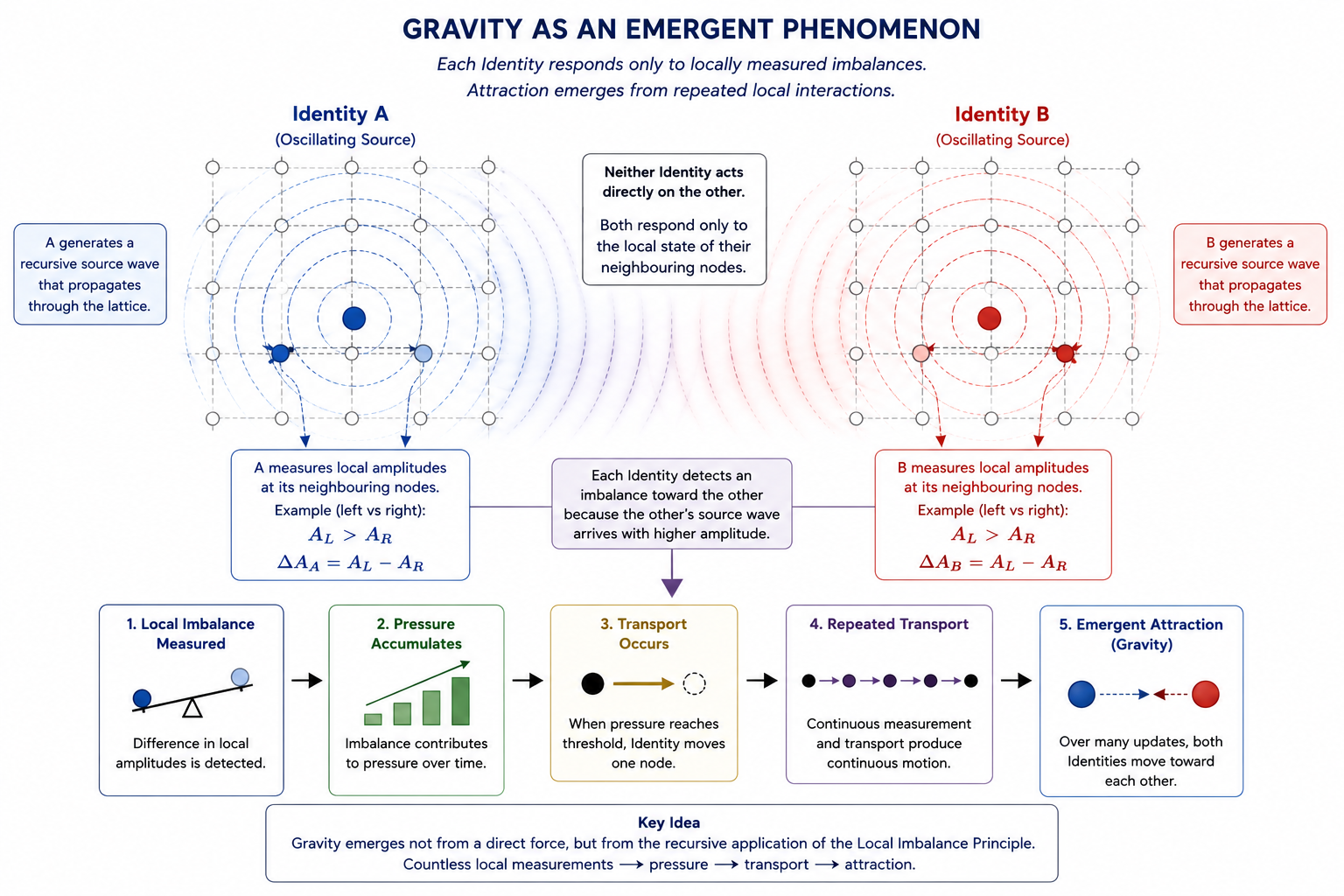
When two Identities continuously generate recursive source waves, each Identity measures the imbalance created by the other.
Neither Identity detects the other directly. Each responds only to the local state of its neighbouring lattice nodes.
Repeated measurements continually accumulate pressure in the direction of the stronger source-wave amplitude.
As transport events accumulate over time, both Identities gradually move toward one another.
Within the REM Framework, this long-term emergent behaviour is investigated as the origin of gravitational attraction.
Why This Is Different
In the REM Framework, gravity is not introduced as a separate interaction.
Instead, attraction emerges from the repeated application of the Local Imbalance Principle.
Every step remains entirely local.
- An Identity measures only neighbouring lattice nodes.
- The measured imbalance accumulates as pressure.
- Pressure produces transport.
- Repeated transport produces attraction.
No direct long-range force is required. The observable behaviour emerges from recursive local interactions throughout the lattice.
Evidence from Simulations
Preliminary REM Framework simulations demonstrate that oscillating Identities generate recursive source waves that produce measurable imbalances within the surrounding lattice.
When these imbalances are repeatedly measured using the Local Imbalance Principle, pressure accumulates and transport occurs toward regions of stronger source-wave amplitude.
These simulations exhibit attraction-like behaviour that motivates further investigation into gravity as an emergent phenomenon rather than a fundamental interaction.
Conclusion
The REM Framework investigates whether gravity emerges naturally from the repeated local measurement of imbalance.
Rather than introducing gravity as an independent force, attraction may arise from countless recursive measurements performed by neighbouring Identities throughout the lattice.
If this interpretation proves correct, gravity becomes one example of a broader principle in which complex physical behaviour emerges from simple local interactions.
This naturally raises the next question.
If gravity depends on measured imbalance, why do some Identities generate stronger imbalances than others?
The next chapter investigates this question through the concept of Mass.
Featured
Introduction
Mass is one of the most familiar quantities in physics. It determines how strongly objects attract one another through gravity and how they respond to applied forces. Modern physics measures mass with extraordinary precision, yet one fundamental question remains:
What is mass?
We know how to measure it.
We know how it behaves.
But do we know what it actually is?
The REM Framework investigates whether mass is not a fundamental property of an object, but an emergent consequence of how strongly an Identity influences the surrounding lattice.
From Gravity to Mass
The previous chapter investigated how repeated local measurements of imbalance may produce gravitational attraction.
This naturally raises another question.
If gravity emerges from measured imbalance, why do some Identities produce stronger attraction than others?
The REM Framework investigates whether the answer lies in the strength of the recursive source wave generated by each Identity.
Stronger Source Waves
Every Identity continuously generates a recursive source wave.
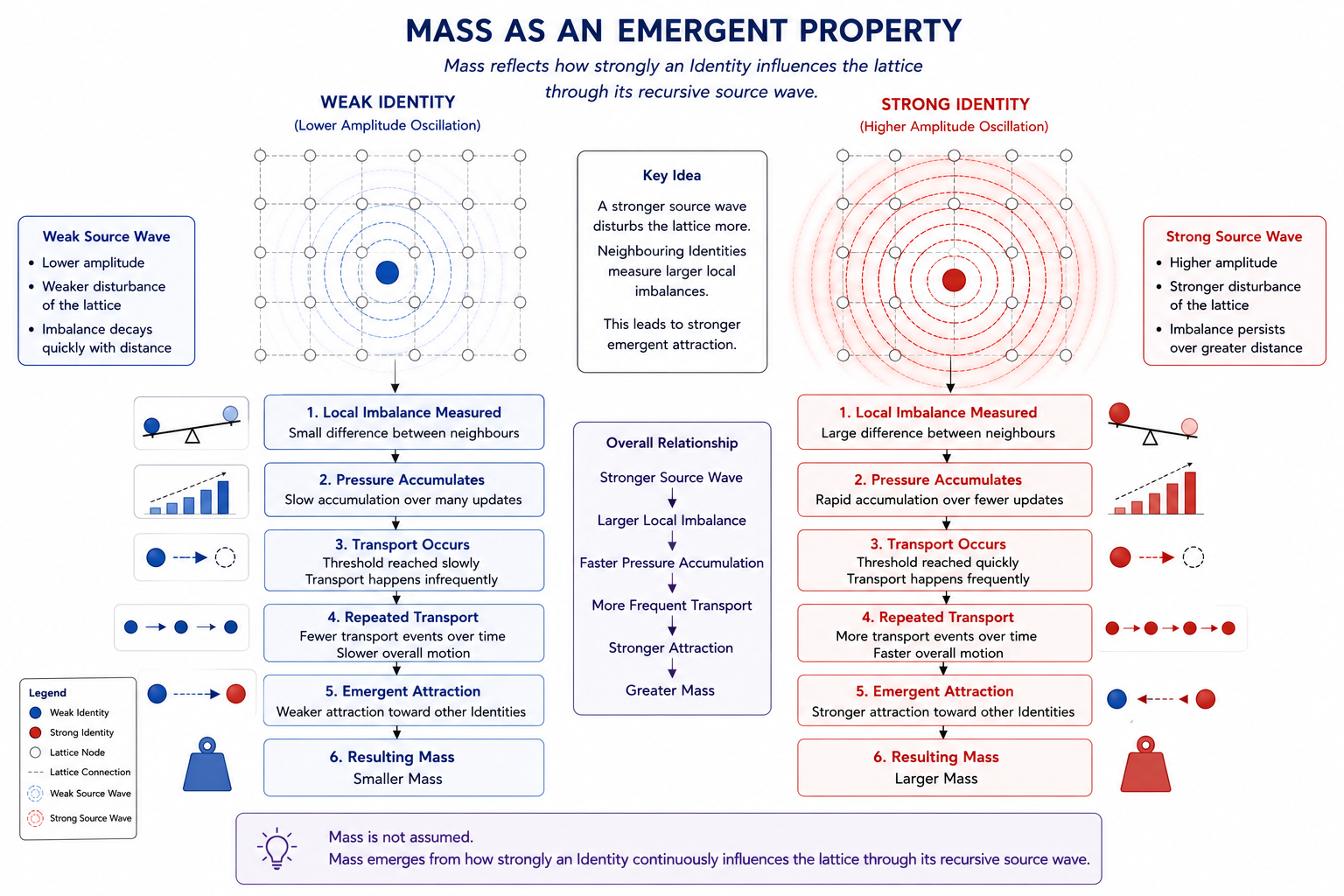
If one Identity generates a stronger source wave than another, neighbouring Identities measure a larger local imbalance.
Larger imbalances accumulate pressure more rapidly.
Pressure reaches the transport threshold sooner.
Transport therefore occurs more frequently.
The result is a stronger emergent attraction.
Stronger Source Wave
↓
Larger Local Imbalance
↓
Faster Pressure Accumulation
↓
More Frequent Transport
↓
Stronger Attraction
↓
Greater Mass
An Emergent Interpretation
Within the REM Framework, mass is not introduced as an independent property.
Instead, it is investigated as an emergent measure of how strongly an Identity continuously influences the surrounding lattice through its recursive source wave.
In this interpretation, stronger source waves generate larger local imbalances, resulting in stronger emergent attraction.
Mass therefore becomes a consequence of recursive lattice dynamics rather than an assumed property of matter.
Evidence from Simulations
Preliminary REM Framework simulations indicate that increasing the oscillation amplitude of an Identity produces stronger recursive source waves and larger measured imbalances in the surrounding lattice.
These larger imbalances increase pressure accumulation and strengthen the resulting attraction between Identities.
Although these observations remain under investigation, they suggest a possible mechanical relationship between source-wave strength and emergent mass.
Why This Matters
If mass emerges from recursive source-wave interactions, it no longer needs to be introduced as a separate fundamental property of nature.
Instead, gravity and mass become different aspects of the same underlying mechanism.
Gravity describes the repeated response to locally measured imbalance.
Mass describes how strongly an Identity generates that imbalance.
Both phenomena therefore arise from the same recursive local principles.
Conclusion
The REM Framework investigates whether mass is an emergent consequence of recursive lattice dynamics rather than a fundamental property of matter.
If stronger recursive source waves generate larger locally measured imbalances, stronger attraction naturally follows through the Local Imbalance Principle.
Although this interpretation remains under investigation, it suggests that gravity and mass may share the same underlying mechanical origin.
Future chapters investigate whether other physical phenomena, including magnetism and electricity, may also emerge from different forms of locally measured imbalance.