Overview
Recursive Node Dynamics describes how every node within the Recursive Emergent Mechanics (REM) Framework evolves during each recursive update. While the Fundamental Node Equation defines how a node computes its acceleration from neighbouring nodes, Recursive Node Dynamics defines the complete mechanical update cycle that transforms one lattice state into the next.
Every node within the lattice follows exactly the same mechanical rules. There are no special nodes, no preferred locations, and no global controller. Each node evolves independently by observing only its directly connected neighbours, making the behaviour of the entire lattice a consequence of purely local recursive interactions.
The repeated execution of this update cycle causes mechanical disturbances to propagate naturally throughout the lattice. As a result, complex global behaviour emerges from the recursive evolution of simple local mechanics.
The Node
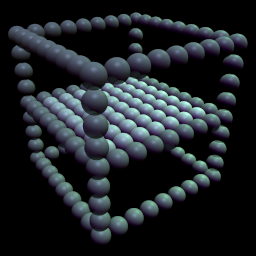
The node is the fundamental mechanical element of the REM Framework. Collectively, nodes form a discrete three-dimensional lattice that represents the underlying mechanical structure of the framework.
Each node occupies a single position within the lattice and maintains direct connections only to its neighbouring nodes. The node itself possesses no knowledge of the global structure of the lattice and cannot interact directly with distant nodes. Every mechanical interaction is therefore completely local.
Although every node follows exactly the same recursive update rule, each node evolves independently according to the mechanical state of its own local neighbourhood. The global behaviour of the lattice therefore emerges from the collective evolution of all nodes rather than from any centralized control mechanism.
Mechanical State
Each node maintains a mechanical state consisting of three fundamental quantities:
- $\mathbf{p}$ — Position
- $\mathbf{v}$ — Velocity
- $\mathbf{a}$ — Acceleration
The position represents the current displacement of the node within the lattice. The velocity describes how the position changes during successive recursive updates, while the acceleration is calculated using the Fundamental Node Equation from the node's neighbouring positions.
Together, these three quantities completely describe the mechanical state of an individual node. No additional intrinsic properties are required for the fundamental Version 0.1 mechanics.
Neighbour Topology
The REM Framework employs a discrete three-dimensional lattice in which every interior node is connected to six neighbouring nodes.
These neighbours correspond to the six orthogonal directions:
- Right
- Left
- Top
- Bottom
- Front
- Back
The Fundamental Node Equation operates exclusively on these neighbouring nodes. Consequently, every recursive update depends only on the local topology surrounding each individual node.
Boundary nodes naturally possess fewer neighbouring connections. The same recursive update rule is applied using only the neighbours that exist, preserving the locality of the framework throughout the lattice.
The Recursive Update Cycle
The evolution of the REM Framework is governed by a recursive update cycle. During each recursive update, every node performs the same sequence of mechanical operations. The updated state of the lattice then becomes the starting point for the next recursive update.
The complete update cycle consists of four successive steps:
- Measure the positions of all neighbouring nodes.
- Calculate the node's acceleration using the Fundamental Node Equation.
- Update the node's velocity.
- Update the node's position.
After every node has completed this sequence, the recursive update is finished and the lattice advances to its next mechanical state. Repeated execution of this cycle produces the continuous evolution of the lattice.
Step 1 — Measuring the Neighbourhood
Each node begins by measuring the relative positions of its directly connected neighbouring nodes. No information beyond the local neighbourhood is required. The node neither stores nor evaluates the state of distant nodes.
For every neighbouring node, the positional difference is determined as:
$$ \Delta\mathbf{p}_i=\mathbf{n}_i-\mathbf{p} $$
where $\mathbf{n}_i$ denotes the position of the i-th neighbouring node and $\mathbf{p}$ is the current node position.
These local positional differences provide the mechanical information required by the Fundamental Node Equation.
Step 2 — Computing the Acceleration
The measured positional differences are averaged to determine the restoring acceleration acting on the node.
$$ \mathbf{a} = \frac{k^{2}}{|N|} \sum_{n\in N} (\mathbf{n}-\mathbf{p}) $$
This equation produces the acceleration that reduces the local mechanical imbalance surrounding the node. When the neighbourhood is perfectly balanced, the average positional difference is zero and the resulting acceleration is also zero.
The acceleration therefore depends exclusively on the current configuration of the neighbouring nodes.
The constant $k$ determines the propagation speed of mechanical disturbances through the lattice. Increasing $k$ increases the rate at which information propagates, while maintaining the recursive structure of the update.
Step 3 — Updating the Velocity
Once the acceleration has been determined, the node updates its velocity by adding the newly computed acceleration to its current velocity.
$$ \mathbf{v}_{n+1} = \mathbf{v}_{n} + \mathbf{a} $$
The updated velocity represents the node's new rate of motion and is immediately used during the position update that follows.
Step 4 — Updating the Position
Finally, the node updates its position using the newly calculated velocity together with the current acceleration.
$$ \mathbf{p}_{n+1} = \mathbf{p}_{n} + \mathbf{v}_{n+1} + \frac{1}{2}\mathbf{a} $$
The updated position represents the mechanical state of the node after one complete recursive update. This new state is then used during the following recursive update together with the updated states of all neighbouring nodes.
Recursive Equilibrium
The recursive update cycle possesses a natural equilibrium state. When every node occupies its equilibrium position, the positional differences between neighbouring nodes become perfectly balanced. Consequently, the Fundamental Node Equation produces zero acceleration.
$$ \mathbf{a} = \mathbf{0} $$
Since the acceleration is zero, the node's velocity remains unchanged. If the lattice is initially at rest, the velocity also remains zero.
$$ \mathbf{v}_{n+1} = \mathbf{v}_{n} $$
Because the velocity does not change, the node position likewise remains unchanged.
$$ \mathbf{p}_{n+1} = \mathbf{p}_{n} $$
The recursive update therefore reproduces exactly the same mechanical state during every subsequent update. The equilibrium configuration is consequently a self-consistent recursive solution of the REM Framework.
Unlike many numerical simulations that require additional stabilization techniques, the stability of the REM Framework follows directly from the recursive mechanics themselves.
Mechanical Restoration
When a node is displaced from its equilibrium position, the balance between neighbouring nodes is disturbed. The resulting positional differences are no longer symmetric, causing the Fundamental Node Equation to generate a restoring acceleration directed toward equilibrium.
The greater the displacement from equilibrium, the larger the resulting restoring acceleration becomes. Every recursive update therefore acts to reduce the local mechanical imbalance within the lattice.
This behaviour causes the lattice to respond as an elastic mechanical medium. Local disturbances generate restoring accelerations that are distributed recursively through neighbouring nodes, allowing mechanical waves to propagate while preserving the lattice's equilibrium configuration.
The recursive update cycle is therefore locally self-correcting. Mechanical disturbances do not destroy the lattice but instead produce temporary deviations that naturally propagate and gradually restore local equilibrium.
A mechanically consistent recursive lattice must possess a locally self-correcting update rule. Without such a restoring mechanism, recursive evolution cannot maintain a stable spatial structure.
Emergence of Mechanical Waves
The self-correcting nature of the recursive update cycle does not immediately restore a displaced node to equilibrium. Instead, the restoring acceleration causes the node to move, altering the mechanical balance experienced by its neighbouring nodes during the following recursive update.
These neighbouring nodes then compute their own restoring accelerations, causing the disturbance to spread recursively throughout the lattice. Mechanical motion is therefore transferred from one local neighbourhood to the next through successive recursive updates.
A mechanical wave is therefore not introduced as a separate object or physical entity. It emerges naturally from the recursive interaction between neighbouring nodes governed by the Fundamental Node Equation.
The lattice behaves as an elastic mechanical medium in which every local disturbance generates a chain of restoring accelerations. The propagation of these restoring interactions forms the mechanical waves observed within the REM Framework.
Wave propagation is therefore an inherent consequence of the recursive mechanics rather than an independent assumption of the framework.
Recursive Stability
The recursive update cycle of the REM Framework is inherently stable because every update is governed by the same local mechanical principles. When the lattice is in equilibrium, each node experiences zero net acceleration, causing the recursive update to reproduce the same mechanical state indefinitely.
When a node is displaced from equilibrium, the resulting acceleration acts to reduce the local mechanical imbalance rather than amplify it. Each recursive update therefore contributes to restoring the equilibrium configuration of the lattice.
Unlike many recursive systems that require additional stabilization techniques, the REM Framework derives its stability directly from the mechanical structure of the Fundamental Node Equation. Stability is therefore an intrinsic property of the recursive mechanics rather than an external correction applied during the simulation.
The recursive update does not attempt to force the lattice toward equilibrium. Instead, equilibrium emerges naturally because the locally averaged positional differences continuously generate restoring accelerations. This self-correcting behaviour allows the lattice to remain mechanically stable while simultaneously supporting the propagation of mechanical disturbances.
Consequently, the REM Framework combines two properties that are both essential for a mechanical lattice: long-term structural stability and the ability to transmit mechanical waves through recursive local interactions.
From Node Dynamics to Wave Propagation
Recursive Node Dynamics describes how individual nodes evolve through successive recursive updates. Although every node follows the same simple mechanical rules, the collective interaction of many nodes produces behaviour that extends beyond the motion of a single node.
When one node is disturbed, the resulting restoring accelerations influence neighbouring nodes during subsequent recursive updates. These neighbouring nodes then generate restoring accelerations of their own, causing the disturbance to propagate throughout the lattice.
Mechanical wave propagation therefore emerges naturally from the recursive interaction of neighbouring nodes. No additional propagation mechanism is introduced beyond the recursive update cycle itself.
The following article explores how this collective behaviour gives rise to propagating mechanical waves and interference patterns within the REM Framework.
Summary
Recursive Node Dynamics describes the complete mechanical evolution of every node within the REM Framework. Beginning with the Fundamental Node Equation, each node recursively computes its acceleration from its neighbouring nodes, updates its velocity, and finally updates its position.
Because every node follows the same local update rule, the lattice naturally maintains its equilibrium while remaining capable of transmitting mechanical disturbances. The recursive interaction between neighbouring nodes gives rise to stable wave propagation without requiring any additional propagation rules or global coordination.
Recursive Node Dynamics therefore provides the mechanical foundation upon which all higher-level mechanisms of the REM Framework are built.
Key Takeaways
- Every node follows the same recursive mechanical update cycle.
- Nodes interact exclusively with their directly connected neighbours.
- The mechanical state of a node consists of its position, velocity, and acceleration.
- The recursive update cycle naturally preserves the lattice's equilibrium configuration.
- Mechanical disturbances propagate recursively through neighbouring nodes as waves.
- Recursive Node Dynamics forms the mechanical foundation for the higher-level mechanisms of the REM Framework.