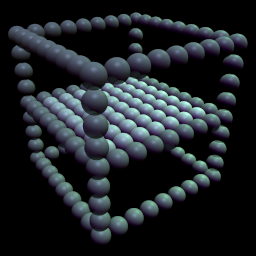
Exploring how complex physical phenomena may emerge from deterministic recursive mechanics on a discrete lattice.
Welcome
Welcome to the official documentation of the REM Framework (Recursive Emergent Mechanics).
The REM Framework is a research framework that investigates whether complex physical phenomena can emerge from a fundamental system of deterministic recursive mechanics operating on a discrete lattice of interconnected nodes.
Rather than assuming particles, fields, or forces as fundamental entities, the framework explores the possibility that these phenomena arise from local interactions, recursive dynamics, oscillatory behavior, and the evolution of stable structures over time.
This website documents the concepts, mathematical foundations, computational simulations, and ongoing development of the REM Framework.
Motivation
Modern physics provides highly successful descriptions of many natural phenomena. However, fundamental questions remain regarding the underlying nature of space, matter, interactions, and gravity.
The REM Framework explores an alternative starting point. Instead of beginning with predefined physical objects or forces, it begins with a discrete system of interconnected nodes governed by recursive mechanical rules.
The central question is:
Can increasingly complex physical behavior emerge naturally from simple local recursive mechanics?
The framework investigates emergence as a fundamental process: complex structures and behaviors arising from repeated interactions of simpler underlying mechanisms.
Core Principles
The REM Framework is based on several foundational principles:
Space is represented by a discrete lattice of interconnected nodes.
Interactions occur locally between neighboring nodes.
The system evolves through deterministic recursive update rules.
Oscillatory dynamics generate disturbances that propagate through the lattice.
Stable structures may emerge from recursive interactions.
Discrete occupancy transport provides a mechanism for motion.
Observable phenomena are investigated as emergent properties of the underlying mechanics.
The formal definitions and mathematical formulation of these principles are developed throughout this documentation.
Current Development Status
The REM Framework is an active research project. Current development is divided into foundational mechanics, demonstrated behavior, and ongoing investigations.
Topic
Status
Stable recursive lattice
Developed
Recursive node dynamics
Developed
Oscillation model
Developed
Wave propagation
Developed
Occupancy and transport
Developed
Pressure mechanism
Developed
Mass-like behavior
Initial simulation evidence
Gravity-like behavior
Initial simulation evidence
Electromagnetic field emergence
Under investigation
Magnetism
Under investigation
Electricity
Planned
Atomic structures
Planned
The distinction between developed mechanics and investigated physical interpretations is maintained throughout the documentation.
Documentation Structure
The REM Framework documentation is organized progressively.
The foundation begins with the fundamental concepts:
Definitions
Axioms
Mathematical notation
Recursive node mechanics
Identity and occupancy
Pressure and transport
The framework then explores emergent behavior:
Wave propagation
Mass-like behavior
Gravity-like behavior
Electromagnetic field emergence
Magnetism
Electricity
Atomic structures
Each topic is presented with its definitions, mathematical formulation, simulation results, interpretation, and open questions.
Research Status
The REM Framework is under active development.
The purpose of this website is to provide a transparent record of the framework's evolution, including:
theoretical concepts,
mathematical development,
simulation experiments,
observed behaviors,
and future research directions.
As the framework develops, this documentation will continue to evolve.
Document Information
Framework: REM Framework Full Name: Recursive Emergent Mechanics Status: Active Development
The REM Framework is an investigation into whether a wide range of physical phenomena can emerge from a single recursive mechanical process. Rather than introducing separate fundamental mechanisms for waves, electricity, magnetism, atoms, mass, and gravity, the framework begins with a small number of simple local mechanical principles and explores what behaviour naturally emerges from them.
The framework is built upon a stationary recursive lattice in which every interaction occurs locally between neighbouring nodes. Within this lattice, persistent oscillators called Identities generate mechanical disturbances that propagate as waves. These waves create local mechanical asymmetries that can be measured by neighbouring Occupancies. Through the accumulation of Pressure and the Transport of Occupancies, increasingly complex behaviour may emerge.
The objective of the REM Framework is not to begin with the known laws of physics, but to investigate whether familiar physical phenomena—including wave propagation, interference, electric charge, magnetism, atoms, mass-like behaviour, and gravity-like behaviour—can all arise from the same recursive emergent mechanics.
The Challenge
Physics has successfully described many natural phenomena using highly developed mathematical theories. Waves, electricity, magnetism, atomic structure, mass, and gravity can all be modelled with remarkable accuracy within their respective domains.
Despite this success, these phenomena are generally introduced through different theoretical frameworks, each designed to describe a particular aspect of nature. This naturally raises an interesting question: could these seemingly different phenomena instead emerge from a common underlying mechanical process?
The REM Framework investigates this possibility. Rather than starting with separate assumptions for wave propagation, electric charge, magnetism, atoms, or gravity, it begins with a single recursive mechanical model and explores which physical phenomena may emerge from its local interactions.
The Philosophy
The REM Framework does not begin by assuming the existence of waves, electric fields, magnetic fields, atoms, mass, or gravity as fundamental entities. Instead, it begins with a small number of simple recursive mechanical principles and investigates what behaviour naturally emerges from them.
The central idea is that complex behaviour can arise from simple local interactions repeated throughout a recursive lattice. Every interaction occurs only between neighbouring lattice nodes, without requiring action at a distance or global coordination. From these local interactions, increasingly complex structures and behaviours may emerge.
Rather than constructing separate models for different physical phenomena, the REM Framework explores whether a common recursive mechanical foundation can give rise to wave propagation, interference, electric charge, magnetism, atomic structures, mass-like behaviour, gravity-like behaviour, and potentially other physical phenomena.
This philosophy guides every part of the REM Framework. The chapters that follow investigate this possibility step by step, beginning with the fundamental structure in which these recursive interactions take place.
Why Recursive Emergent Mechanics?
The name Recursive Emergent Mechanics (REM) reflects the three fundamental ideas that form the foundation of the framework. Rather than being an arbitrary name, each word describes an essential characteristic of the model.
Recursive refers to the repeated application of the same local mechanical rules throughout the stationary lattice. Every lattice node follows the same update procedure, interacting only with its directly connected neighbouring nodes. By repeating these simple rules recursively, increasingly complex behaviour can develop across the lattice.
Emergent expresses the primary objective of the REM Framework: to investigate whether complex physical phenomena can arise naturally from simple local interactions. Instead of introducing separate mechanisms for waves, electric charge, magnetism, atoms, mass, or gravity, the framework explores whether these behaviours emerge from a common recursive mechanical foundation.
Mechanics emphasizes that every interaction within the framework is mechanical in nature. Motion, wave propagation, pressure, and transport are all consequences of local mechanical interactions between neighbouring lattice nodes.
Together, these three ideas define the philosophy of the REM Framework: a recursive mechanical system in which increasingly complex physical behaviour may emerge from simple local interactions.
Recursive Updates and Time
The REM Framework describes the evolution of the lattice as a sequence of recursive updates. During each update, every lattice node recalculates its mechanical state using only the information available from its neighbouring nodes. Once all nodes have been updated, the process repeats.
Rather than beginning with the assumption of a continuously flowing external time variable, the framework models temporal evolution through this ordered sequence of recursive updates. Each completed update represents one progression of the mechanical state of the lattice.
As recursive updates continue, local interactions accumulate, disturbances propagate, and increasingly complex behaviour emerges. In this way, recursion provides not only the computational mechanism of the framework, but also its progression from one state to the next.
Why a Discrete Lattice?
The REM Framework adopts a discrete lattice as the fundamental structure in which all mechanical interactions take place. This choice is deliberate and forms one of the core principles of the framework.
Many physical theories describe space and time as continuous, allowing infinitely many possible positions and infinitely many intermediate moments between any two points in time. Such descriptions have proven mathematically successful and are widely used throughout physics. The REM Framework, however, investigates a different starting point by representing the universe as a sequence of discrete mechanical states.
Each state describes the complete configuration of the lattice at a particular moment. Every lattice node has a well-defined mechanical state, and every recursive update transforms the entire lattice from one complete state into the next. In this way, the evolution of the framework is represented by an ordered sequence of discrete states rather than by continuous change.
A useful analogy is a motion picture. Although a movie appears to display continuous motion, it is actually composed of a sequence of individual frames shown one after another. Each frame is a complete snapshot, while the illusion of continuous motion emerges from their ordered progression. The REM Framework follows a similar principle: every recursive update produces a new complete state of the lattice.
Within the REM Framework, a moment represents one complete state of the recursive lattice. Moments are discrete and ordered: moment 1, moment 2, moment 3, and so on. There is no intermediate moment between two completed recursive updates because no intermediate lattice state exists.
This discrete representation provides a well-defined mechanical foundation in which every state follows directly from the previous one. The REM Framework investigates whether increasingly complex physical phenomena can emerge from this recursive progression of discrete mechanical states.
The Source of Motion
A perfectly stationary lattice remains in mechanical equilibrium. Without a local disturbance, no wave propagation or interaction can occur. The REM Framework therefore introduces a localized oscillator that continuously excites the surrounding lattice.
This localized oscillator is called an Identity. An Identity occupies a single lattice node and produces a continuous mechanical oscillation. Rather than moving the lattice itself, this oscillation generates a mechanical disturbance that propagates recursively through neighbouring nodes as a Source Wave.
This simple idea forms the starting point for all subsequent behaviour within the REM Framework.
The following chapters examine the Identity and its oscillatory behaviour in detail. Before doing so, it is useful to understand how the disturbances produced by an Identity propagate through the recursive lattice.
The First Emergent Behaviour
When an Identity begins to oscillate, its motion disturbs the surrounding lattice. Because each lattice node interacts recursively with its neighbouring nodes, this disturbance is not confined to a single location. Instead, it propagates outward through the lattice as a mechanical wave.
This wave is the first observable emergent behaviour of the REM Framework. It is not introduced as a separate physical entity, but arises naturally from the recursive interactions between neighbouring lattice nodes. The lattice itself remains stationary while only the mechanical disturbance propagates.
As the disturbance spreads through the lattice, its amplitude gradually decreases with distance from the originating Identity. This creates subtle differences in the mechanical state of neighbouring lattice nodes, providing the information required for later stages of the framework.
The propagation of these disturbances also allows multiple waves to overlap. Where waves meet, they naturally reinforce or cancel one another through the recursive dynamics of the lattice, producing interference patterns without requiring additional interaction rules.
Wave propagation therefore provides the bridge between a localized oscillation and the collective behaviour of the recursive lattice.
Mechanical Asymmetry
As the Source Wave propagates away from an Identity, its amplitude decreases with distance. Consequently, neighbouring lattice nodes generally experience slightly different mechanical states. The lattice therefore becomes locally asymmetric.
This mechanical asymmetry contains directional information. By comparing opposite neighbouring directions, an Occupancy can determine where the disturbance is strongest and therefore infer the direction of the originating Source Wave.
The Occupancy does not detect another Identity directly. Instead, it measures the local mechanical asymmetry created by the propagated wave. This distinction is fundamental to the REM Framework, because every interaction remains local while still allowing information about distant disturbances to emerge.
The Journey Ahead
The concepts introduced in this chapter provide a high-level view of the REM Framework. They describe the overall mechanism without examining the individual components in detail.
The chapters that follow investigate each stage of this mechanism step by step. Beginning with the Fundamental Node Equation, they develop the recursive dynamics of the lattice before introducing wave propagation, Identities, Occupancies, Pressure, and Transport. From these foundations, the framework explores whether increasingly complex phenomena—including atoms, electric charge, magnetism, mass-like behaviour, and gravity-like behaviour—can emerge naturally.
The purpose of this journey is not simply to describe known physical phenomena, but to investigate whether they can all be understood as different manifestations of the same recursive emergent mechanics.
The REM Framework (Recursive Emergent Mechanics) describes a discrete mechanical system using mathematical structures that represent nodes, relationships, states, and recursive evolution.
The mathematical model provides a formal language for describing how local interactions produce global system behavior.
The framework is based on a discrete lattice where each element follows defined update rules and interacts with neighboring elements.
Lattice Representation
The fundamental structure of the REM Framework is a discrete lattice.
A lattice can be represented as a collection of nodes:
$$ L=\{N_1,N_2,N_3,...,N_m\} $$
where:
$L$ represents the complete lattice.
$N_i$ represents an individual node.
$m$ represents the total number of nodes.
Each node has a defined position within the lattice.
For a three-dimensional lattice, the position of a node can be represented as:
$$ \vec{x_i}=(x_i,y_i,z_i) $$
where $\vec{x_i}$ represents the spatial position of node $i$.
Node State
Each node contains a set of properties that define its current mechanical state.
The state of a node can be represented as:
$$ N_i=(\vec{x_i},\vec{v_i},\vec{a_i}) $$
where:
$\vec{x_i}$ represents the node position.
$\vec{v_i}$ represents the node velocity.
$\vec{a_i}$ represents the node acceleration.
The complete state of the lattice is determined by the combined state of all nodes.
$$ S=\{N_1,N_2,N_3,...,N_m\} $$
Neighbor Relationships
The REM Framework assumes that interactions occur through local neighbor relationships.
Each node has a defined set of connected neighboring nodes.
The neighbor relationship can be represented as:
$$ \mathcal{N}(N_i)=\{N_j,N_k,...\} $$
where $\mathcal{N}(N_i)$ represents the neighboring nodes connected to node $N_i$.
For a three-dimensional lattice with six directional connections, a node may interact with:
positive X direction,
negative X direction,
positive Y direction,
negative Y direction,
positive Z direction,
negative Z direction.
Local Interaction Function
The evolution of a node is determined by the influence of its neighboring nodes.
The local interaction can be represented as:
$$ I_i=G(N_i,\mathcal{N}(N_i)) $$
where:
$I_i$ represents the interaction result for node $i$.
$G$ represents the local interaction function.
This ensures that large-scale behavior emerges from repeated local interactions.
Recursive State Evolution
The REM Framework describes system evolution as a sequence of discrete updates.
At each update step, the current state of the system is transformed into the next state through the recursive update function:
$$ S_{n+1}=F(S_n) $$
where:
$S_n$ represents the complete system state at update step $n$.
$S_{n+1}$ represents the resulting state after the update.
$F$ represents the complete recursive update mechanism.
The recursive update contains the rules that determine interactions, motion, oscillations, and other mechanical processes within the system.
Node Dynamics
The movement of nodes is determined by their position, velocity, and acceleration.
The acceleration of a node is calculated from the influence of its neighboring nodes and local interactions.
The velocity update can be represented as:
$$ \vec{v}_{n+1}=\vec{v}_n+\vec{a}_n $$
where:
$\vec{v}_n$ represents the current velocity.
$\vec{a}_n$ represents the calculated acceleration.
The position update is then calculated from the updated motion:
$$ \vec{x}_{n+1}=\vec{x}_n+\vec{v}_{n+1} $$
This creates a recursive mechanical evolution where the future configuration of the lattice depends on its previous configuration.
Gradient Measurement
The REM Framework uses local differences between neighboring nodes to measure directional changes within the lattice.
A gradient represents the difference between a node property and the corresponding properties of neighboring nodes.
For a scalar property $P$, the local gradient can be represented as:
$$ \nabla P_i=P_j-P_i $$
where:
$P_i$ represents the property value at node $i$.
$P_j$ represents the property value at a neighboring node.
The gradient provides a measure of local imbalance and can influence the resulting mechanical response of the system.
Identity Representation
An identity is represented as a localized dynamic structure within the lattice.
The mathematical representation of an identity may include:
$$ I=(N,f,A,\phi) $$
where:
$N$ represents the occupied node location.
$f$ represents the oscillation frequency.
$A$ represents the oscillation amplitude.
$\phi$ represents the phase information.
The identity is maintained through continuous recursive interaction with the surrounding lattice.
Occupancy Representation
Occupancy describes the relationship between an identity and a node.
The occupancy relation can be represented as:
$$ O(I,N) $$
where:
$I$ represents the identity.
$N$ represents the occupied node.
The occupancy relation determines where an identity exists within the lattice at a given update step.
Movement occurs when the occupancy relation transfers from one node to another:
$$ O(I,N_i)\rightarrow O(I,N_j) $$
where $N_j$ is a neighboring node selected according to the transport rules.
Pressure Representation
In the REM Framework, pressure is defined as an occupancy-local quantity.
Pressure belongs to the relationship between an identity and the occupied node rather than being an independent property of either element.
The pressure state can be represented as:
$$ P=P(I,N) $$
where:
$P$ represents the occupancy pressure.
$I$ represents the identity.
$N$ represents the occupied node.
Pressure accumulation occurs through recursive interaction and may contribute to discrete transport when defined threshold conditions are reached.
Transport Mathematics
Within the REM Framework, identities do not move continuously through space. Instead, motion is represented by discrete transfers of occupancy between neighboring nodes.
An identity occupies exactly one node at any given recursive update step. Movement occurs only when the occupancy relationship is transferred to a neighboring node.
The occupancy transfer can be represented as:
$$ O(I,N_i)\rightarrow O(I,N_j) $$
where:
$I$ represents the identity.
$N_i$ represents the currently occupied node.
$N_j$ represents the destination neighboring node.
Unlike continuous motion, transport within the REM Framework consists of a sequence of discrete occupancy transfers. Continuous trajectories therefore emerge from many individual transport events.
Pressure-Driven Transport
Transport is driven by the accumulation of occupancy-local pressure.
Pressure is generated through recursive interactions between an identity and the surrounding lattice. As neighboring nodes interact, pressure accumulates on the occupancy relationship until transport becomes possible.
The pressure associated with an occupied node is represented as:
$$ P=P(I,N) $$
Transport becomes possible when the accumulated pressure reaches a transport threshold:
$$ P \ge P_{\mathrm{threshold}} $$
Once the threshold is reached, the occupancy relationship may transfer to the neighboring node determined by the transport rules.
This mechanism naturally separates continuous wave propagation within the lattice from the discrete movement of identities.
Gradient-Directed Motion
The direction of transport is determined by the local mechanical environment.
The REM Framework evaluates directional gradients generated by neighboring interactions. These gradients provide directional information used during occupancy transfer.
The local gradient may be represented as:
$$ \vec{G}=\nabla M $$
where $M$ represents the measured mechanical quantity used to evaluate the local environment.
During transport, the destination node is selected according to the transport rules that evaluate the surrounding gradients and occupancy pressure.
Dynamic Stability
The lattice itself remains mechanically stable throughout recursive evolution.
Rather than transporting the lattice, the REM Framework transports occupancy relationships between stable lattice locations.
This distinction allows wave propagation to coexist with discrete transport while preserving the structural integrity of the lattice.
Stable structures therefore emerge from the interaction between:
recursive node dynamics,
oscillatory behavior,
pressure accumulation,
and occupancy transport.
Complete System Representation
At any recursive update step, the complete REM Framework can be described by:
$$ R=(L,S,O,P) $$
where:
$L$ represents the lattice structure.
$S$ represents the complete mechanical state of all nodes.
$O$ represents the set of occupancy relationships.
$P$ represents the occupancy-local pressure associated with each occupied node.
The recursive evolution of the REM Framework is therefore represented by:
$$ R_{n+1}=F(R_n) $$
where every recursive update simultaneously evolves the lattice mechanics, occupancy relationships, pressure accumulation, and transport behavior.
Summary
The mathematical structure of the REM Framework combines discrete mechanics with recursive evolution.
The framework is built upon:
a discrete lattice of interconnected nodes,
recursive node dynamics,
localized identities,
occupancy relationships,
occupancy-local pressure,
gradient-directed transport,
and deterministic recursive evolution.
Together, these mathematical structures provide the formal foundation for investigating the emergence of increasingly complex physical behavior.
Next Article
Recursive Node Dynamics
The next article introduces the recursive mechanical equations that govern node behavior, including position, velocity, acceleration, local interactions, and wave propagation within the lattice.
The axioms of the REM Framework (Recursive Emergent Mechanics) define the fundamental assumptions upon which the framework is constructed.
These axioms establish the basic rules and principles used to describe the discrete system, its evolution, and the emergence of higher-level behavior.
The purpose of the axioms is not to directly describe all physical phenomena, but to define the minimal mechanical foundation from which such phenomena can be investigated.
Axiom 1: Discrete Structure
The REM Framework assumes that the fundamental structure of the system is discrete.
Space is represented as a collection of interconnected locations called nodes. These nodes form a lattice structure where each node has defined relationships with neighboring nodes.
The discrete lattice can be represented as:
$$ L=\{N_1,N_2,N_3,...,N_m\} $$
where $L$ represents the lattice and each $N_i$ represents an individual node.
The discrete structure provides the foundation for local interactions and recursive evolution.
Axiom 2: Local Interaction
The REM Framework assumes that interactions occur locally between connected elements of the lattice.
A node directly influences only its connected neighboring nodes. Global behavior emerges through the repeated propagation of local interactions.
The influence of a node can be represented as:
$$ N_i \rightarrow N_j $$
where $N_i$ affects neighboring node $N_j$ through defined mechanical rules.
This principle ensures that complex behavior develops from local processes rather than predefined global behavior.
Axiom 3: Recursive Evolution
The REM Framework assumes that the system evolves through repeated recursive updates.
The state of the system at a future update step is determined from the current state:
$$ S_{n+1}=F(S_n) $$
where:
$S_n$ represents the current state of the system.
$S_{n+1}$ represents the next state.
$F$ represents the recursive update rules.
The same fundamental update mechanism is repeatedly applied throughout the evolution of the system.
Axiom 4: Deterministic Evolution
The REM Framework assumes that the evolution of the system follows deterministic mechanical rules.
Given the complete state of the system, the next state is determined by the recursive update mechanism.
This means that:
$$ S_n \rightarrow S_{n+1} $$
is defined by the rules of the framework and does not require random external input.
Deterministic evolution does not prevent complex behavior. Instead, complex behavior can emerge from the repeated interaction of simple deterministic processes.
Axiom 5: Emergence
The REM Framework assumes that higher-level phenomena can emerge from lower-level mechanical interactions.
The fundamental system does not require separate rules for every observed phenomenon. Instead, new behaviors may arise from the collective behavior of the underlying mechanics.
Examples of investigated emergent behavior include:
wave propagation,
stable structures,
mass-like behavior,
gravity-like behavior,
electromagnetic field behavior.
Axiom 6: Identity and Occupancy
The REM Framework assumes that persistent dynamic structures can exist within the lattice.
These structures are called identities.
An identity is not defined as a fundamental particle. Instead, it is a persistent pattern of activity maintained through recursive interactions with the lattice.
An identity exists within the lattice through an occupancy relationship:
Occupancy describes the relationship between an identity and its current lattice location.
Movement occurs through discrete transfer of occupancy between neighboring nodes rather than continuous movement through space.
Axiom 7: Occupancy-Local Pressure
The REM Framework assumes that pressure is associated with the occupancy relationship between an identity and a node.
Pressure is not considered an inherent property of the identity or the node independently. Instead, it exists as a property of the interaction created by occupancy.
This relationship can be represented as:
$$ P=P(I,N) $$
where:
$P$ represents occupancy pressure.
$I$ represents the identity.
$N$ represents the occupied node.
Pressure can accumulate through recursive interactions and can influence transport when defined conditions are reached.
Axiom 8: Stability Through Dynamic Balance
The REM Framework assumes that stable structures can emerge from balanced recursive interactions.
A stable structure does not require the absence of motion. Instead, stability may arise from continuous dynamic processes maintaining a persistent pattern.
The framework investigates stability as an emergent result of:
local interactions,
recursive updates,
oscillatory behavior,
energy redistribution.
Summary of Axioms
The REM Framework is built upon the following fundamental principles:
Discrete Structure: The system is represented by interconnected discrete nodes.
Local Interaction: Nodes influence their connected neighbors through mechanical rules.
Recursive Evolution: The system evolves through repeated state updates.
Deterministic Evolution: The future state follows from the current state.
Emergence: Higher-level behavior arises from lower-level interactions.
Identity and Occupancy: Persistent structures exist through relationships with lattice locations.
Occupancy-Local Pressure: Pressure belongs to the identity-node relationship.
Dynamic Stability: Stable structures emerge through balanced recursive processes.
Next Article
Mathematical Structure
The next article defines the mathematical representation of the REM Framework, including:
lattice representation,
node states,
neighbor relationships,
recursive update equations,
and the mathematical description of emergent behavior.
This article defines the fundamental concepts and terminology used throughout the REM Framework (Recursive Emergent Mechanics).
These definitions establish the foundation required for understanding the mathematical structure, recursive mechanics, simulations, and emergent phenomena described in later articles.
REM Framework
The REM Framework (Recursive Emergent Mechanics) is a research framework that investigates how complex physical phenomena may emerge from deterministic recursive mechanics operating within a discrete system.
The framework begins with fundamental mechanical elements and studies how repeated local interactions can produce higher-level structures and behaviors.
Discrete Lattice
A discrete lattice is the underlying spatial structure of the REM Framework.
The lattice consists of a finite or extendable collection of interconnected positions called nodes. Each node has defined relationships with neighboring nodes, allowing information and mechanical effects to propagate through local interactions.
Unlike a continuous space representation, the lattice describes space as a collection of discrete elements.
Node
A node is a fundamental element of the discrete lattice.
Each node represents a location within the lattice and contains the mechanical properties required for recursive evolution.
A node can participate in local interactions with neighboring nodes and contributes to the overall state of the system.
State
The state of the REM Framework represents the complete description of the system at a specific recursive update step.
The state contains all information required to determine the next state through the recursive update rules.
The evolution of the system can be represented as:
$$ S_{n+1}=F(S_n) $$
where $S_n$ represents the current state and $F$ represents the recursive update mechanism.
Recursive Update
A recursive update is the process by which the current state of the system determines the next state.
The REM Framework assumes that the evolution of the system occurs through repeated application of the same underlying update principles.
Each update depends on the previous state of the system rather than requiring external information about future states.
Identity
An identity is a localized dynamic structure within the REM Framework.
An identity represents a persistent pattern of activity that can occupy a location within the lattice and interact with the surrounding mechanical environment.
An identity is not defined as a fundamental particle. Instead, it is considered an emergent structure maintained through recursive interactions.
Occupancy
Occupancy describes the relationship between an identity and a node location in the lattice.
In the REM Framework, an identity occupies a node through a discrete occupancy relationship.
The occupancy relation provides the mechanism through which identities can move through the lattice by transferring between neighboring nodes.
Oscillation
An oscillation is a repeating dynamic variation within the system.
Oscillatory behavior represents a fundamental mechanism through which identities interact with the lattice and generate propagating disturbances.
Oscillations may occur in different directions and can contribute to emergent wave behavior.
Pressure
Pressure is a persistent scalar quantity associated with the occupancy relationship between an identity and a node.
In the REM Framework, pressure is not considered a property of the identity alone or the node alone. Instead, it belongs to the relationship created by an identity occupying a specific node.
Pressure can accumulate through recursive interactions and may influence transport behavior when defined conditions are reached.
Transport
Transport describes the discrete movement mechanism of identities through the lattice.
Rather than assuming continuous movement through space, the REM Framework describes motion as a sequence of occupancy transfers between neighboring nodes.
Transport emerges from the interaction between identity dynamics, pressure, and local lattice conditions.
Wave Propagation
Wave propagation describes the transmission of disturbances through the lattice.
A disturbance created at one location can influence neighboring nodes through recursive interactions, allowing patterns of oscillation to travel through the system.
Wave propagation is considered a developed mechanical behavior within the REM Framework.
Emergent Behavior
Emergent behavior describes higher-level properties that arise from the interaction of simpler underlying mechanisms.
In the REM Framework, phenomena are investigated as possible emergent consequences of recursive mechanics rather than being introduced as independent fundamental rules.
Examples of investigated emergent behavior include:
stable structures,
mass-like behavior,
gravity-like behavior,
electromagnetic field emergence.
Summary
The REM Framework begins with a small set of fundamental concepts:
Discrete lattice
Nodes
Recursive updates
Identities
Occupancy
Oscillations
Pressure
Transport
The purpose of the framework is to investigate how increasingly complex behavior can emerge from these fundamental mechanical principles.
Next Article
Axioms
The next article defines the fundamental assumptions and principles upon which the REM Framework is constructed.