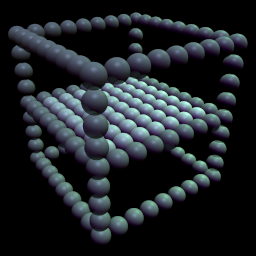
The REM Framework can be understood as a sequence of simple local processes:
Identity
    ↓
Oscillation
    ↓
Source Wave
    ↓
Recursive Wave Propagation
    ↓
Mechanical Asymmetry
    ↓
Directional Imbalance
    ↓
Pressure
    ↓
Transport
    ↓
Emergent Behaviour
Each step follows directly from the previous one. Together they describe how localized oscillations can produce complex behaviour without requiring non-local interactions or movement of the lattice itself.
Mechanical Asymmetry
An oscillating Identity produces a mechanical wave whose amplitude decreases with distance as it propagates through the recursive lattice. As a result, neighbouring lattice nodes generally do not experience identical mechanical states.
This local asymmetry allows an Occupancy to compare opposite neighbouring directions. By measuring these differences, it can determine the direction of the originating disturbance without directly interacting with the Identity itself.
Mechanical asymmetry is therefore one of the fundamental ideas of the REM Framework. It provides the information from which Pressure, Transport, and later mass-like and gravity-like behaviour emerge.
Emergent Behaviour
The purpose of the Core Mechanism extends beyond Identity transport. The same local processes that govern wave propagation and Occupancy movement also give rise to increasingly complex behaviour as larger collections of interacting Identities evolve.
Within the REM Framework, mass-like and gravity-like behaviour are not introduced as fundamental assumptions. Instead, they are investigated as emergent consequences of the recursive mechanical interactions described by the Core Mechanism.
Subsequent chapters explore each stage of this mechanism in detail and examine how increasingly complex physical behaviour emerges from these simple local principles.
Looking Ahead
The Core Mechanism provides a high-level view of how the REM Framework operates. Each chapter that follows examines one stage of this mechanism in greater detail, beginning with the fundamental role of the Identity.