Overview
The REM Framework is an investigation into whether a wide range of physical phenomena can emerge from a single recursive mechanical process. Rather than introducing separate fundamental mechanisms for waves, electricity, magnetism, atoms, mass, and gravity, the framework begins with a small number of simple local mechanical principles and explores what behaviour naturally emerges from them.
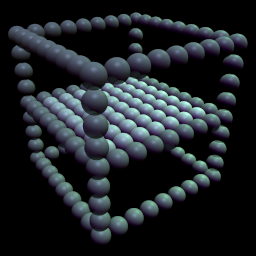
The framework is built upon a stationary recursive lattice in which every interaction occurs locally between neighbouring nodes. Within this lattice, persistent oscillators called Identities generate mechanical disturbances that propagate as waves. These waves create local mechanical asymmetries that can be measured by neighbouring Occupancies. Through the accumulation of Pressure and the Transport of Occupancies, increasingly complex behaviour may emerge.
The objective of the REM Framework is not to begin with the known laws of physics, but to investigate whether familiar physical phenomena—including wave propagation, interference, electric charge, magnetism, atoms, mass-like behaviour, and gravity-like behaviour—can all arise from the same recursive emergent mechanics.
The Challenge
Physics has successfully described many natural phenomena using highly developed mathematical theories. Waves, electricity, magnetism, atomic structure, mass, and gravity can all be modelled with remarkable accuracy within their respective domains.
Despite this success, these phenomena are generally introduced through different theoretical frameworks, each designed to describe a particular aspect of nature. This naturally raises an interesting question: could these seemingly different phenomena instead emerge from a common underlying mechanical process?
The REM Framework investigates this possibility. Rather than starting with separate assumptions for wave propagation, electric charge, magnetism, atoms, or gravity, it begins with a single recursive mechanical model and explores which physical phenomena may emerge from its local interactions.
The Philosophy
The REM Framework does not begin by assuming the existence of waves, electric fields, magnetic fields, atoms, mass, or gravity as fundamental entities. Instead, it begins with a small number of simple recursive mechanical principles and investigates what behaviour naturally emerges from them.
The central idea is that complex behaviour can arise from simple local interactions repeated throughout a recursive lattice. Every interaction occurs only between neighbouring lattice nodes, without requiring action at a distance or global coordination. From these local interactions, increasingly complex structures and behaviours may emerge.
Rather than constructing separate models for different physical phenomena, the REM Framework explores whether a common recursive mechanical foundation can give rise to wave propagation, interference, electric charge, magnetism, atomic structures, mass-like behaviour, gravity-like behaviour, and potentially other physical phenomena.
This philosophy guides every part of the REM Framework. The chapters that follow investigate this possibility step by step, beginning with the fundamental structure in which these recursive interactions take place.
Why Recursive Emergent Mechanics?
The name Recursive Emergent Mechanics (REM) reflects the three fundamental ideas that form the foundation of the framework. Rather than being an arbitrary name, each word describes an essential characteristic of the model.
Recursive refers to the repeated application of the same local mechanical rules throughout the stationary lattice. Every lattice node follows the same update procedure, interacting only with its directly connected neighbouring nodes. By repeating these simple rules recursively, increasingly complex behaviour can develop across the lattice.
Emergent expresses the primary objective of the REM Framework: to investigate whether complex physical phenomena can arise naturally from simple local interactions. Instead of introducing separate mechanisms for waves, electric charge, magnetism, atoms, mass, or gravity, the framework explores whether these behaviours emerge from a common recursive mechanical foundation.
Mechanics emphasizes that every interaction within the framework is mechanical in nature. Motion, wave propagation, pressure, and transport are all consequences of local mechanical interactions between neighbouring lattice nodes.
Together, these three ideas define the philosophy of the REM Framework: a recursive mechanical system in which increasingly complex physical behaviour may emerge from simple local interactions.
Recursive Updates and Time
The REM Framework describes the evolution of the lattice as a sequence of recursive updates. During each update, every lattice node recalculates its mechanical state using only the information available from its neighbouring nodes. Once all nodes have been updated, the process repeats.
Rather than beginning with the assumption of a continuously flowing external time variable, the framework models temporal evolution through this ordered sequence of recursive updates. Each completed update represents one progression of the mechanical state of the lattice.
As recursive updates continue, local interactions accumulate, disturbances propagate, and increasingly complex behaviour emerges. In this way, recursion provides not only the computational mechanism of the framework, but also its progression from one state to the next.
Why a Discrete Lattice?
The REM Framework adopts a discrete lattice as the fundamental structure in which all mechanical interactions take place. This choice is deliberate and forms one of the core principles of the framework.
Many physical theories describe space and time as continuous, allowing infinitely many possible positions and infinitely many intermediate moments between any two points in time. Such descriptions have proven mathematically successful and are widely used throughout physics. The REM Framework, however, investigates a different starting point by representing the universe as a sequence of discrete mechanical states.
Each state describes the complete configuration of the lattice at a particular moment. Every lattice node has a well-defined mechanical state, and every recursive update transforms the entire lattice from one complete state into the next. In this way, the evolution of the framework is represented by an ordered sequence of discrete states rather than by continuous change.
A useful analogy is a motion picture. Although a movie appears to display continuous motion, it is actually composed of a sequence of individual frames shown one after another. Each frame is a complete snapshot, while the illusion of continuous motion emerges from their ordered progression. The REM Framework follows a similar principle: every recursive update produces a new complete state of the lattice.
Within the REM Framework, a moment represents one complete state of the recursive lattice. Moments are discrete and ordered: moment 1, moment 2, moment 3, and so on. There is no intermediate moment between two completed recursive updates because no intermediate lattice state exists.
This discrete representation provides a well-defined mechanical foundation in which every state follows directly from the previous one. The REM Framework investigates whether increasingly complex physical phenomena can emerge from this recursive progression of discrete mechanical states.
The Source of Motion
A perfectly stationary lattice remains in mechanical equilibrium. Without a local disturbance, no wave propagation or interaction can occur. The REM Framework therefore introduces a localized oscillator that continuously excites the surrounding lattice.
This localized oscillator is called an Identity. An Identity occupies a single lattice node and produces a continuous mechanical oscillation. Rather than moving the lattice itself, this oscillation generates a mechanical disturbance that propagates recursively through neighbouring nodes as a Source Wave.
This simple idea forms the starting point for all subsequent behaviour within the REM Framework.
The following chapters examine the Identity and its oscillatory behaviour in detail. Before doing so, it is useful to understand how the disturbances produced by an Identity propagate through the recursive lattice.
The First Emergent Behaviour
When an Identity begins to oscillate, its motion disturbs the surrounding lattice. Because each lattice node interacts recursively with its neighbouring nodes, this disturbance is not confined to a single location. Instead, it propagates outward through the lattice as a mechanical wave.
This wave is the first observable emergent behaviour of the REM Framework. It is not introduced as a separate physical entity, but arises naturally from the recursive interactions between neighbouring lattice nodes. The lattice itself remains stationary while only the mechanical disturbance propagates.
As the disturbance spreads through the lattice, its amplitude gradually decreases with distance from the originating Identity. This creates subtle differences in the mechanical state of neighbouring lattice nodes, providing the information required for later stages of the framework.
The propagation of these disturbances also allows multiple waves to overlap. Where waves meet, they naturally reinforce or cancel one another through the recursive dynamics of the lattice, producing interference patterns without requiring additional interaction rules.
Wave propagation therefore provides the bridge between a localized oscillation and the collective behaviour of the recursive lattice.
Mechanical Asymmetry
As the Source Wave propagates away from an Identity, its amplitude decreases with distance. Consequently, neighbouring lattice nodes generally experience slightly different mechanical states. The lattice therefore becomes locally asymmetric.
This mechanical asymmetry contains directional information. By comparing opposite neighbouring directions, an Occupancy can determine where the disturbance is strongest and therefore infer the direction of the originating Source Wave.
The Occupancy does not detect another Identity directly. Instead, it measures the local mechanical asymmetry created by the propagated wave. This distinction is fundamental to the REM Framework, because every interaction remains local while still allowing information about distant disturbances to emerge.
The Journey Ahead
The concepts introduced in this chapter provide a high-level view of the REM Framework. They describe the overall mechanism without examining the individual components in detail.
The chapters that follow investigate each stage of this mechanism step by step. Beginning with the Fundamental Node Equation, they develop the recursive dynamics of the lattice before introducing wave propagation, Identities, Occupancies, Pressure, and Transport. From these foundations, the framework explores whether increasingly complex phenomena—including atoms, electric charge, magnetism, mass-like behaviour, and gravity-like behaviour—can emerge naturally.
The purpose of this journey is not simply to describe known physical phenomena, but to investigate whether they can all be understood as different manifestations of the same recursive emergent mechanics.