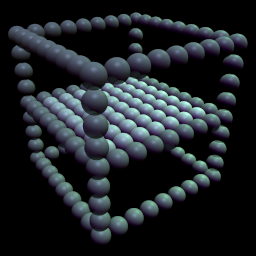
One of the fundamental questions in the REM Framework is not how matter behaves, but rather why persistent structures exist at all. If every disturbance naturally spreads through the lattice and eventually returns to equilibrium, why does the universe contain objects that continue to exist?
The REM Framework approaches this question by introducing the concept of an Identity. An Identity is not assumed to be a particle, a field, or a physical object in the conventional sense. Instead, it represents the simplest irreducible entity currently required for constructing an emergent universe.
Why is an Identity Necessary?
The recursive lattice continuously seeks mechanical equilibrium. Whenever a node is disturbed, the disturbance propagates through neighbouring nodes until the lattice gradually returns to its equilibrium state. This behaviour produces stable wave propagation, but it also reveals an important limitation: ordinary disturbances do not persist indefinitely.
Without an additional mechanism, every excitation eventually disappears. Consequently, a universe consisting solely of recursive lattice dynamics would contain waves, but no persistent localized structures capable of representing matter.
The Identity is therefore introduced as the simplest known mechanism capable of maintaining a localized excitation while remaining completely embedded within the lattice. At the current stage of the REM Framework, the Identity is treated as an irreducible assumption. Whether such persistence can eventually emerge from simpler recursive dynamics remains an open research question.
What is an Identity?
An Identity is a persistent oscillator occupying exactly one lattice node at any given update. It continuously excites the surrounding lattice through its oscillatory motion while remaining mechanically coupled to neighbouring nodes.
The Identity is not the lattice itself. The lattice defines space. The Identity introduces persistent activity within that space.
Unlike traditional particles, an Identity does not possess intrinsic mass or gravitational properties. Instead, these properties are expected to emerge from the recursive interaction between the oscillating Identity and the surrounding lattice.
Oscillation
Each Identity oscillates according to a configurable oscillation function. The oscillation may occur along one, two or three spatial axes and may use different waveform types, including sinusoidal, cosine or square oscillations.
The oscillation itself is not intended to represent a physical particle moving through space. Instead, it acts as the continuous mechanical excitation responsible for generating recursive lattice disturbances.
Different oscillation amplitudes, frequencies and orientations may eventually produce different emergent phenomena, such as gravitational attraction, wave interference, magnetism or other physical behaviour. Determining these relationships remains an important area of future investigation.
Persistence
Persistence is one of the defining characteristics of an Identity. Unlike ordinary disturbances, which naturally disperse throughout the lattice, an Identity continuously maintains its oscillatory behaviour.
This persistence allows information to remain localized while simultaneously generating continuous recursive interactions with neighbouring nodes. Without persistence, long-lived structures could not exist, and an emergent universe would consist only of transient waves.
Relationship with the Lattice
The lattice remains stationary. Only local node positions oscillate around their equilibrium locations. The Identity therefore does not move the lattice itself, but continuously excites the recursive dynamics already defined by the Fundamental Node Equation.
The recursive lattice and the Identity fulfil different roles. The lattice provides the mechanical structure of space, while the Identity provides persistent localized excitation. Neither replaces the other. Together they form the foundation upon which increasingly complex emergent behaviour can develop.
Current Status
The REM Framework currently considers the Identity to be an irreducible assumption. Extensive investigation has been carried out to determine whether persistent oscillations can emerge directly from recursive lattice dynamics. Although self-sustaining oscillations can be constructed under specific conditions, no general mechanism has yet been found that naturally produces persistent localized structures without introducing additional assumptions.
For this reason, the Identity presently remains one of the fundamental building blocks of the framework. Future research may eventually reveal a deeper mechanism from which the Identity itself can emerge.
Looking Forward
An oscillating Identity continuously excites the surrounding lattice, but how can such an excitation remain localized while the lattice itself remains stationary? How can an Identity move through the lattice without transporting the lattice itself?
These questions lead directly to the next concept in the REM Framework: Occupancy.