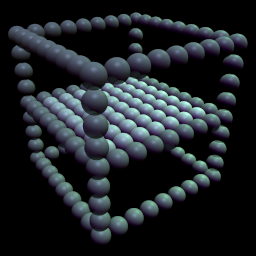
The previous chapter introduced the concept of an Identity as a persistent localized oscillator. An Identity continuously excites the surrounding lattice, but this immediately raises a fundamental question.
If the lattice itself represents space and remains mechanically connected, how can an Identity move without transporting the lattice along with it? In other words, how can persistent activity travel through a stationary universe?
The REM Framework answers this question through the concept of Occupancy. Rather than moving the lattice itself, an Identity changes which node it occupies. The lattice remains stationary while the Identity transfers from one node to another.
Why is Occupancy Necessary?
Without Occupancy, an Identity would remain permanently attached to a single lattice node. Its oscillation would generate waves, but it could never travel through space. Motion would therefore require the physical movement of the lattice itself, destroying the fixed geometric structure upon which the REM Framework is built.
The REM Framework instead separates two fundamentally different concepts. The lattice provides the stationary structure of space, while the Identity provides persistent localized activity. Occupancy forms the relationship between these two.
This separation allows space itself to remain stable while persistent structures move through it.
What is Occupancy?
Occupancy describes the relationship between an Identity and a lattice node. At every update, each Identity occupies exactly one node, and each occupied node contains exactly one Identity.
An Occupancy is therefore not an object by itself. It is the connection between a persistent Identity and a specific location within the lattice.
As an Identity moves, the Occupancy changes. The lattice nodes remain exactly where they are, but the Identity becomes associated with a neighbouring node.
Occupancy as a Physical Relationship
Within the REM Framework, Occupancy is more than a simple reference between two objects. It represents the physical relationship through which an Identity interacts with the surrounding lattice.
Because this relationship persists over time, it can also store local physical information. Rather than attaching every physical property directly to either the Identity or the lattice node, certain quantities naturally belong to the Occupancy itself.
One important example is transport pressure. Pressure is not a property of the lattice, because empty lattice nodes possess no transport behaviour. Likewise, it is not solely a property of the Identity, because transport depends upon the local interaction between the Identity and the node it currently occupies. Instead, pressure belongs to the Occupancy and moves together with the Identity as it transfers through the lattice.
Changing Occupancy
Occupancy is not permanent. Whenever local conditions favour movement, an Identity transfers from its current node to one of its neighbouring nodes.
This transfer changes only the Occupancy. The lattice itself does not move. The previous node becomes unoccupied, while the neighbouring node becomes occupied by the same persistent Identity.
Successive Occupancy transfers create the appearance of continuous motion, even though every individual movement consists only of local changes between neighbouring nodes.
Emergent Motion
From the perspective of an external observer, an Identity appears to move smoothly through space. Internally, however, the REM Framework performs no continuous translation. Instead, movement emerges from a sequence of discrete Occupancy transfers between neighbouring lattice nodes.
Because every transfer is purely local, all interactions remain local as well. No Identity ever jumps across multiple nodes or requires information from distant regions of the lattice. This locality is one of the fundamental principles of the REM Framework.
Current Status
Occupancy is currently treated as a fundamental concept within the REM Framework. It provides the mechanism that separates the stationary geometry of the lattice from the motion of persistent structures.
This distinction allows the REM Framework to describe movement without requiring space itself to flow or deform as objects travel through it. Whether Occupancy can ultimately emerge from an even deeper principle remains an open question for future research.
Looking Forward
An Identity can now move through the lattice by changing its Occupancy, but another important question immediately follows.
What determines when an Occupancy should change? Why does an Identity move in one direction rather than another? And how can movement emerge entirely from local interactions without introducing external forces?
These questions lead directly to the next concept in the REM Framework: Pressure.