rem-framework.com
  • Home
  • Fundamental Principles
    • Introduction
    • Definitions
    • Axioms
    • Mathematical Structure
  • Fundamental Mechanics
    • Fundamental Node Equation
    • Recursive Node Dynamics
    • Wave Propagation
    • Identity
    • Occupancy
    • Pressure
    • Transport
    • Imbalance
  • Emergent Physics
    • Emergence
    • Gravity
    • Mass
    • Electricity
    • Magnetism
    • Electromagnetic Field
    • Entropy
  • Emergent Organization
    • Stable Configurations
    • Compound Identities
    • Atom-like Structures
  • Validation
    • Double-Slit Experiment
    • Stability Analysis
    • Simulation Results
  • Development
    • Origin of the REM Framework
    • Roadmap
    • Changelog
  • Download
  • Contact
  • Featured
Featured

Introduction

D.Q. Nguyen Fundamental Principles 20 July 2026 20 July 2026

The Motivation and Philosophy of the REM Framework

The REM Framework (Recursive Emergent Mechanics) is a research framework that investigates how complex physical phenomena may emerge from simple deterministic recursive mechanics operating within a discrete system.

The framework begins with a different starting point from many conventional approaches. Instead of assuming particles, fields, forces, or spacetime as fundamental entities, the REM Framework explores whether these phenomena can arise as emergent consequences of underlying mechanical rules.

The central idea is that complexity does not necessarily require complex fundamental principles. A system governed by simple local interactions can develop organized structures and behaviors through repeated recursive evolution.


The Fundamental Question

The REM Framework is built around a fundamental question:

Can the behavior of the physical universe emerge from a small set of local recursive mechanical principles?

To investigate this question, the framework starts with a discrete lattice of interconnected nodes. Each node follows defined update rules and interacts only with neighboring nodes.

Through repeated recursive updates, the system can produce:

  • oscillations,
  • wave propagation,
  • stable structures,
  • transport behavior,
  • and interactions between emergent structures.

The objective is not to assume these phenomena as fundamental, but to investigate whether they can naturally arise from the underlying mechanics.


A Different Starting Point

Many existing physical descriptions begin with concepts such as:

  • particles,
  • fields,
  • forces,
  • energy,
  • spacetime.

The REM Framework explores a different direction:

Begin with the mechanics that could generate these concepts.

Within this approach:

  • A wave is not assumed as a fundamental object, but emerges from recursive interactions.
  • Motion is not assumed as continuous movement through space, but emerges through discrete transport mechanisms.
  • Stable structures are not assumed as particles, but emerge from persistent recursive patterns.
  • Interactions are not introduced as separate forces, but emerge from the behavior of the underlying system.

This places emergence at the center of the framework.


Emergence as a Principle

Emergence describes how higher-level behavior can arise from lower-level interactions.

Examples in nature include:

  • collective behavior from many interacting individuals,
  • complex patterns from simple physical processes,
  • organized structures from repeated interactions.

The REM Framework applies this principle to fundamental mechanics.

The framework investigates whether:

$$ \text{simple recursive mechanics} $$

can lead to:

$$ \text{complex physical behavior} $$

through repeated interactions over time.


The Role of Recursion

Recursion is the central mechanism of the REM Framework.

At each update step, the current state of the system determines the next state.

The recursive evolution of the system can be represented as:

$$ S_{n+1}=F(S_n) $$

where:

  • $S_n$ represents the complete state of the system at update step $n$.
  • $F$ represents the recursive update mechanism.

The next state is determined entirely from the previous state. The system does not require external information about future states.

Through many recursive iterations, simple local rules can generate increasingly complex behavior.


Research Approach

The REM Framework combines:

  • mathematical formulation,
  • computational simulation,
  • analysis of emergent behavior,
  • and progressive refinement of the underlying mechanics.

The development follows a bottom-up approach:

$$ \text{Local Mechanics} $$

$$ \downarrow $$

$$ \text{Recursive Dynamics} $$

$$ \downarrow $$

$$ \text{Emergent Structures} $$

$$ \downarrow $$

$$ \text{Observable Behavior} $$

This approach allows each emerging phenomenon to be studied from its underlying mechanism.


Scope of Investigation

The REM Framework currently investigates several areas.

Developed Foundations

  • Discrete lattice mechanics
  • Recursive node dynamics
  • Oscillatory behavior
  • Wave propagation
  • Occupancy-based transport
  • Pressure accumulation mechanisms

Emerging Phenomena Under Investigation

  • Mass-like behavior
  • Gravity-like behavior
  • Electromagnetic field emergence
  • Magnetism
  • Electricity
  • Atomic structures

The framework maintains a distinction between:

  • developed mechanical principles,
  • simulation observations,
  • and open research questions.

Philosophy of the Framework

The REM Framework follows a guiding principle:

Physical complexity may emerge from recursive simplicity.

Rather than introducing increasingly complex fundamental rules, the framework investigates whether complex behavior can arise naturally from the repeated interaction of a small number of underlying mechanical principles.


Next Article

Definitions

The next article introduces the fundamental terminology of the REM Framework:

  • Node
  • Identity
  • Occupancy
  • Oscillation
  • Pressure
  • Transport
  • Recursive Update

These definitions establish the language required for the mathematical and mechanical descriptions that follow.
Featured

Imbalance

D.Q. Nguyen Fundamental Mechanics 26 July 2026 26 July 2026


Introduction

The previous chapters introduced the concepts of Pressure and Transport, explaining how an Identity moves through the lattice. However, one fundamental question remains:

Why does transport begin at all?

Before an Identity can respond to its surroundings, it must first detect that one direction differs from another. Without such a difference, every neighbouring direction is mechanically equivalent, no pressure accumulates, and no transport occurs.

The REM Framework calls this local difference an imbalance.

This chapter introduces the concept of imbalance and the Local Imbalance Principle, which proposes that an Identity responds only to locally measured differences in the state of its neighbouring lattice nodes. This principle provides the mechanical foundation for investigating how physical phenomena may emerge from recursive local interactions.


Perfect Equilibrium

Consider an Identity surrounded by neighbouring lattice nodes that are all in exactly the same mechanical state. Every neighbouring direction contains identical information. No direction is preferred over another.

Under these conditions the lattice is in local equilibrium. Since no measurable difference exists between neighbouring nodes, no imbalance is detected, no pressure accumulates, and the Identity remains stationary.

A perfectly balanced environment therefore produces no physical response.


Breaking the Equilibrium

An oscillating Identity continuously generates a recursive source wave that propagates through the surrounding lattice.

As the source wave travels outward, its amplitude gradually decreases with distance from the source. When this wave reaches another Identity, the neighbouring lattice nodes no longer experience identical amplitudes.

The local equilibrium has now been broken.

This difference between neighbouring measurements is called an imbalance.


The Local Imbalance Principle

The REM Framework proposes the following principle:

An Identity never responds directly to distant objects. It responds only to locally measured differences in the state of its neighbouring lattice nodes.

This principle is entirely local. An Identity does not observe where another Identity is located, nor does it require information about distant parts of the lattice. Every decision is based solely on measurements performed within its immediate neighbourhood.

Complex behaviour may therefore emerge from repeated local interactions without requiring any non-local communication.


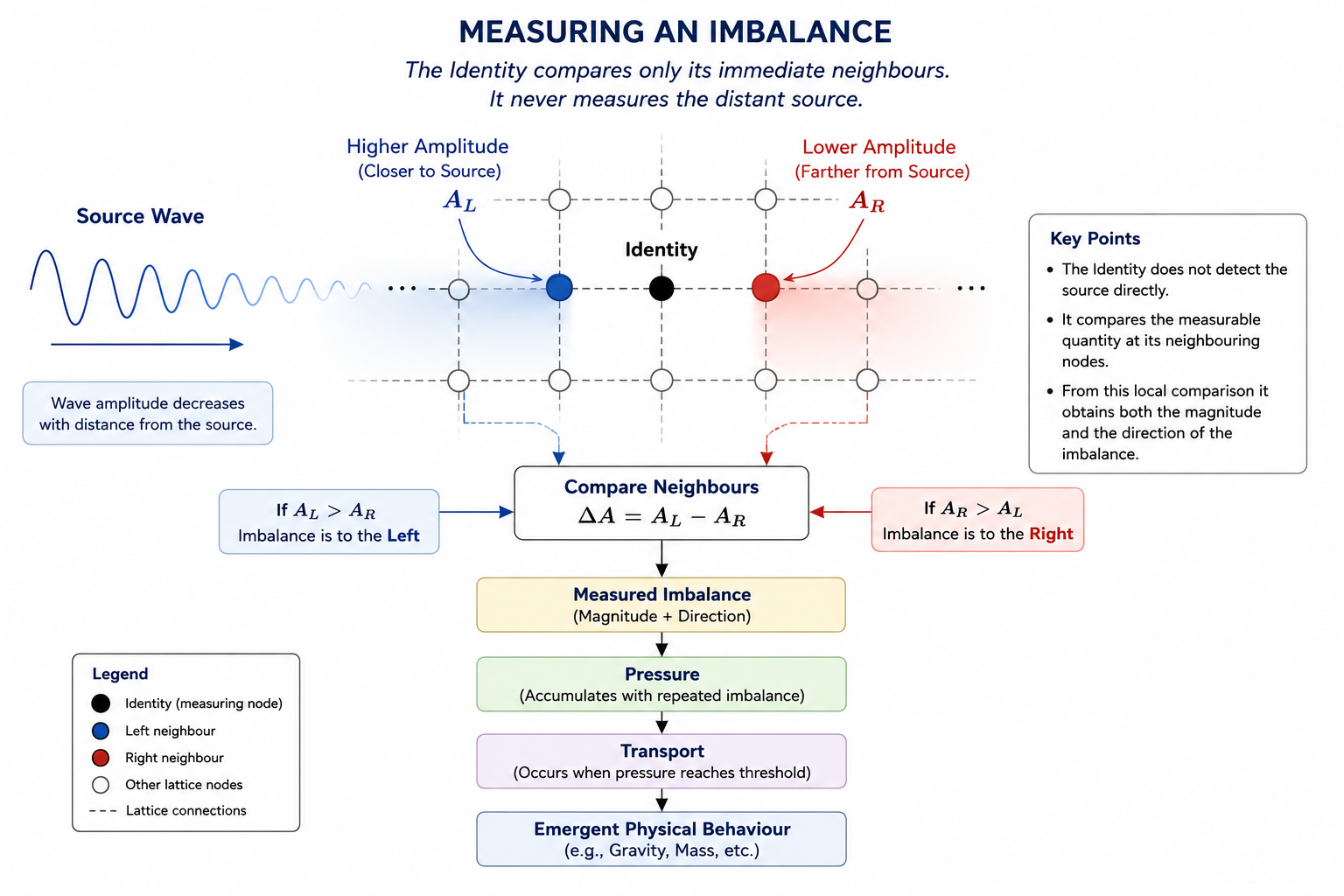
Measuring an Imbalance

Suppose a recursive source wave approaches an Identity from the left.

Because the wave amplitude decreases with distance from its source, the neighbouring node on the left measures a slightly larger amplitude than the neighbouring node on the right.

In other words,

$A_{left} > A_{right}$

The Identity compares the amplitudes measured by its neighbouring nodes and calculates their difference,

$\Delta A = A_{left} - A_{right}$

This local comparison immediately provides two pieces of information:

  • the magnitude of the imbalance, and
  • the direction from which the source wave arrived.

The Identity therefore never measures the distant source directly. It measures only the local state of the lattice surrounding it.


REM Imbalance


Why This Principle Matters

The Local Imbalance Principle introduces a general mechanical mechanism for responding to the surrounding lattice.

In this chapter the imbalance is determined by comparing recursive source-wave amplitudes measured across neighbouring lattice nodes. However, the REM Framework is not restricted to amplitude alone.

Future investigations may reveal other locally measurable quantities capable of defining an imbalance, including:

  • source-wave amplitude,
  • node position,
  • node velocity,
  • node acceleration,
  • rotational properties of the lattice,
  • or other locally measurable quantities that emerge as the framework develops.

Although the measured quantity may differ, the underlying principle remains unchanged: an Identity responds only to locally measured imbalances.


Conclusion

The concept of imbalance provides the missing link between the fundamental mechanics of the REM Framework and the emergence of physical phenomena.

Rather than introducing separate mechanisms for every interaction, the REM Framework investigates whether different physical phenomena originate from different kinds of locally measured imbalances while following the same underlying Local Imbalance Principle.

If this principle proves applicable across multiple phenomena, it may provide a unified mechanical foundation for understanding how complex behaviour emerges from recursive local interactions.

The next chapter investigates the first application of this principle: Gravity.

Featured

Fundamental Mechanics

D.Q. Nguyen Fundamental Mechanics 22 July 2026 22 July 2026

The REM Framework can be understood as a sequence of simple local processes:

Identity
    ↓
Oscillation
    ↓
Source Wave
    ↓
Recursive Wave Propagation
    ↓
Mechanical Asymmetry
    ↓
Directional Imbalance
    ↓
Pressure
    ↓
Transport
    ↓
Emergent Behaviour

Each step follows directly from the previous one. Together they describe how localized oscillations can produce complex behaviour without requiring non-local interactions or movement of the lattice itself.


Mechanical Asymmetry

An oscillating Identity produces a mechanical wave whose amplitude decreases with distance as it propagates through the recursive lattice. As a result, neighbouring lattice nodes generally do not experience identical mechanical states.

This local asymmetry allows an Occupancy to compare opposite neighbouring directions. By measuring these differences, it can determine the direction of the originating disturbance without directly interacting with the Identity itself.

Mechanical asymmetry is therefore one of the fundamental ideas of the REM Framework. It provides the information from which Pressure, Transport, and later mass-like and gravity-like behaviour emerge.


Emergent Behaviour

The purpose of the Core Mechanism extends beyond Identity transport. The same local processes that govern wave propagation and Occupancy movement also give rise to increasingly complex behaviour as larger collections of interacting Identities evolve.

Within the REM Framework, mass-like and gravity-like behaviour are not introduced as fundamental assumptions. Instead, they are investigated as emergent consequences of the recursive mechanical interactions described by the Core Mechanism.

Subsequent chapters explore each stage of this mechanism in detail and examine how increasingly complex physical behaviour emerges from these simple local principles.


Looking Ahead

The Core Mechanism provides a high-level view of how the REM Framework operates. Each chapter that follows examines one stage of this mechanism in greater detail, beginning with the fundamental role of the Identity.

Featured

Transport

D.Q. Nguyen Fundamental Mechanics 22 July 2026 22 July 2026

The previous chapter introduced Pressure as the accumulated local imbalance experienced by an Occupancy. Pressure explains why movement becomes favourable, but it does not explain how movement actually occurs.

This leads to the final question of this sequence. How can continuous motion emerge if the lattice itself remains stationary and an Identity occupies only one node at a time?

The REM Framework answers this question through Transport. Transport is the process by which an Identity changes its Occupancy from one lattice node to another. Rather than moving continuously through space, motion emerges from a sequence of local Occupancy transfers.


Why is Transport Necessary?

Without Transport, Pressure could accumulate indefinitely without ever producing movement. The framework would describe the tendency to move, but no actual motion would occur.

Transport therefore converts accumulated Pressure into physical movement. It provides the final step connecting local mechanical interactions with the observable motion of persistent structures.

Together, Identity, Occupancy, Pressure and Transport form a complete mechanism for emergent movement.


What is Transport?

Transport is the process by which an Identity transfers its Occupancy from its current lattice node to one of its neighbouring nodes. Only neighbouring nodes participate in each transfer. No long-distance movement or global knowledge is required.

When a transfer occurs, the Identity itself remains unchanged. Only the Occupancy changes. The previous node becomes unoccupied while the neighbouring node becomes occupied by the same persistent Identity.

The lattice itself remains stationary throughout the entire process.


When Does Transport Occur?

Transport does not occur continuously. Instead, accumulated Pressure is compared against the transport conditions established by the framework.

Once sufficient Pressure has accumulated along one direction, the Occupancy transfers to the neighbouring node corresponding to that direction.

Following the transfer, the Pressure associated with the previous Occupancy is reset or updated according to the transport rules, allowing the process to begin again at the new location.


Locality

Every Transport event is completely local. An Identity never skips nodes and never requires information beyond its immediate neighbourhood.

This locality is one of the central principles of the REM Framework. Complex motion emerges entirely from repeated local interactions without requiring global forces or non-local communication.

The path followed by an Identity therefore emerges naturally from many individual local decisions rather than from a predetermined trajectory.


Emergent Motion

Although each individual Transport event moves an Identity by only one lattice node, repeated Occupancy transfers produce smooth macroscopic motion.

From the perspective of an external observer, an Identity appears to move continuously through space. Internally, however, every movement consists only of discrete transitions between neighbouring nodes.

Continuous motion therefore emerges from discrete recursive dynamics.


Emergent Velocity and Momentum

Velocity is not assigned directly to an Identity. Instead, it emerges from the frequency and direction of successive Transport events. An Identity that transports more frequently appears to move faster than one whose Pressure accumulates more slowly.

Likewise, momentum is expected to emerge from the continued accumulation and redistribution of Pressure during repeated Occupancy transfers rather than existing as an independent fundamental property.

These quantities therefore arise naturally from the recursive dynamics instead of being introduced as separate assumptions.


The Complete Mechanism

The four concepts introduced throughout these chapters form a single recursive process.

An Identity continuously excites the surrounding lattice. Its Occupancy determines where this excitation occurs. Local mechanical imbalances accumulate as Pressure. Once sufficient Pressure has developed, Transport transfers the Occupancy to a neighbouring node. The process then repeats recursively.

No global controller directs movement. Every observable trajectory emerges entirely from local recursive interactions.


Current Status

The Transport mechanism provides the final component required for describing motion within the REM Framework. Movement is not fundamental but emerges from the interaction between Identity, Occupancy, Pressure and recursive lattice dynamics.


Conclusion

Pressure explains how an Identity is transported through the lattice, but it does not explain why transport begins. Before pressure can accumulate, an Identity must first detect a difference in its local surroundings. Without such a difference, every neighbouring direction remains mechanically equivalent, no pressure is accumulated, and no transport occurs.

The REM Framework proposes that every physical response begins with the Local Imbalance Principle: an Identity responds only to locally measured differences in the state of its neighbouring lattice nodes. The Identity does not detect distant objects directly. Instead, it compares the measurable properties of its immediate neighbours and responds only to the resulting imbalance.

This principle provides a purely local mechanical foundation for transport and introduces a unified way of investigating emergent behaviour. Rather than requiring separate mechanisms for different physical phenomena, the REM Framework explores whether gravity, electricity, magnetism and other interactions may originate from different kinds of locally measured imbalances.

The next chapter introduces the concept of Imbalance and explains how local measurements may determine both the magnitude and the direction of an emerging physical response.

Future research will investigate how increasingly complex phenomena—including gravitational attraction, magnetism, electric charge, atomic structure and other physical behaviour—can emerge from this same recursive mechanism.


Looking Forward

The REM Framework has now introduced the fundamental concepts required to describe persistent structures and their motion within a stationary recursive lattice.

The next stage is no longer to define new building blocks, but to investigate the physical phenomena that emerge from their interaction. How can waves produce attraction? How can rotating oscillations produce magnetism? How can local transport generate electric current? And how can increasingly complex structures eventually give rise to the universe we observe?

The remainder of the REM Framework explores these questions by allowing complex behaviour to emerge from the simple recursive principles established in the preceding chapters.

Featured

Pressure

D.Q. Nguyen Fundamental Mechanics 22 July 2026 22 July 2026

The previous chapter introduced Occupancy as the mechanism that allows an Identity to move through a stationary lattice. However, another fundamental question immediately follows.

If an Identity occupies a lattice node, why should it ever leave that node? What determines when movement begins, and why does it occur in one direction rather than another?

The REM Framework answers these questions through the concept of Pressure. Pressure does not directly move an Identity. Instead, it represents the accumulated local imbalance experienced by an Occupancy as it interacts with the surrounding lattice.


Why is Pressure Necessary?

Without Pressure, movement would have to occur immediately whenever a small imbalance appears. Such behaviour would make motion extremely sensitive to tiny fluctuations and would produce unrealistic jittering as Occupancies constantly change between neighbouring nodes.

Instead, the REM Framework allows small local imbalances to accumulate over time. Only after sufficient imbalance has developed does movement become favourable. This introduces stability while preserving completely local interactions.

Pressure therefore provides the missing link between local mechanical imbalance and eventual movement.


What is Pressure?

Pressure is a persistent quantity associated with an Occupancy. It measures the accumulated directional imbalance experienced by an Identity while occupying a particular lattice node.

Unlike the instantaneous lattice gradient, Pressure does not disappear after each update. Instead, it accumulates over successive recursive updates, preserving the mechanical history of the local interaction.

This persistence allows weak influences to combine naturally over time until they become significant enough to produce movement.


Why Does Pressure Belong to the Occupancy?

Pressure is not a property of the lattice itself. Empty lattice nodes possess no transport behaviour.

Neither is Pressure purely a property of the Identity. The same Identity experiences different local conditions depending upon which node it currently occupies.

Pressure therefore belongs to the relationship between the Identity and the lattice node. It is a property of the Occupancy itself and transfers together with the Identity whenever Occupancy changes.


Measuring Local Imbalance

Each recursive update measures the local imbalance surrounding the occupied node. Neighbouring nodes influence the Occupancy differently depending upon their relative mechanical state.

These local measurements produce a directional gradient. Rather than immediately causing movement, this gradient contributes to the accumulated Pressure stored by the Occupancy.

As long as an imbalance remains, Pressure continues to increase in the corresponding direction. If the imbalance disappears, Pressure no longer increases.


Accumulation

Pressure is one of the few quantities within the REM Framework that remembers previous updates. Each measurement contributes to the existing Pressure, allowing many small influences to combine into a larger effect.

This accumulation introduces a natural form of inertia. Movement is no longer determined by a single instantaneous measurement but by the continuous mechanical history of the Occupancy.

The longer a consistent imbalance exists, the greater the accumulated Pressure becomes.


Pressure is not Motion

An important distinction within the REM Framework is that Pressure does not itself move an Identity. Pressure only represents the tendency for movement to occur.

Movement begins only when the accumulated Pressure exceeds the conditions required for an Occupancy transfer. This separation between accumulation and movement keeps the recursive dynamics stable while allowing motion to emerge naturally from local interactions.


Current Status

Within the REM Framework, Pressure is currently treated as a persistent quantity belonging to the Occupancy. It provides the mechanism by which repeated local interactions gradually build the conditions required for movement.

This approach avoids instantaneous reactions to small fluctuations while allowing motion to emerge from entirely local recursive dynamics. Future research may reveal additional emergent behaviour resulting from Pressure accumulation beyond transport alone.


Looking Forward

Pressure now provides a tendency for movement, but another question remains.

At what point should accumulated Pressure actually change an Occupancy? How is the direction of movement chosen? And how can repeated local transfers produce smooth continuous motion?

These questions lead directly to the next concept in the REM Framework: Transport.

  1. Occupancy
  2. Identity
  3. Wave Propagation
  4. Fundamental Node Equation
  • 1
  • 2
  • 3
  • 4
Page 2 of 4
© 2026 SmartBlackBox

Main Menu

  • Home
  • Fundamental Principles
    • Introduction
    • Definitions
    • Axioms
    • Mathematical Structure
  • Fundamental Mechanics
    • Fundamental Node Equation
    • Recursive Node Dynamics
    • Wave Propagation
    • Identity
    • Occupancy
    • Pressure
    • Transport
    • Imbalance
  • Emergent Physics
    • Emergence
    • Gravity
    • Mass
    • Electricity
    • Magnetism
    • Electromagnetic Field
    • Entropy
  • Emergent Organization
    • Stable Configurations
    • Compound Identities
    • Atom-like Structures
  • Validation
    • Double-Slit Experiment
    • Stability Analysis
    • Simulation Results
  • Development
    • Origin of the REM Framework
    • Roadmap
    • Changelog
  • Download
  • Contact
  • Featured